PROJECT DOSSIER · FinTech & Payments
CodegoKYC Identity Verification
Secure digital identity verification platform supporting document scanning and biometric liveness checks.
- Status
- Live
- Role
- Flutter Developer
- Period
- 2024 - 2026
- Platforms
- Android · iOS
01 / ORIGIN
Product context
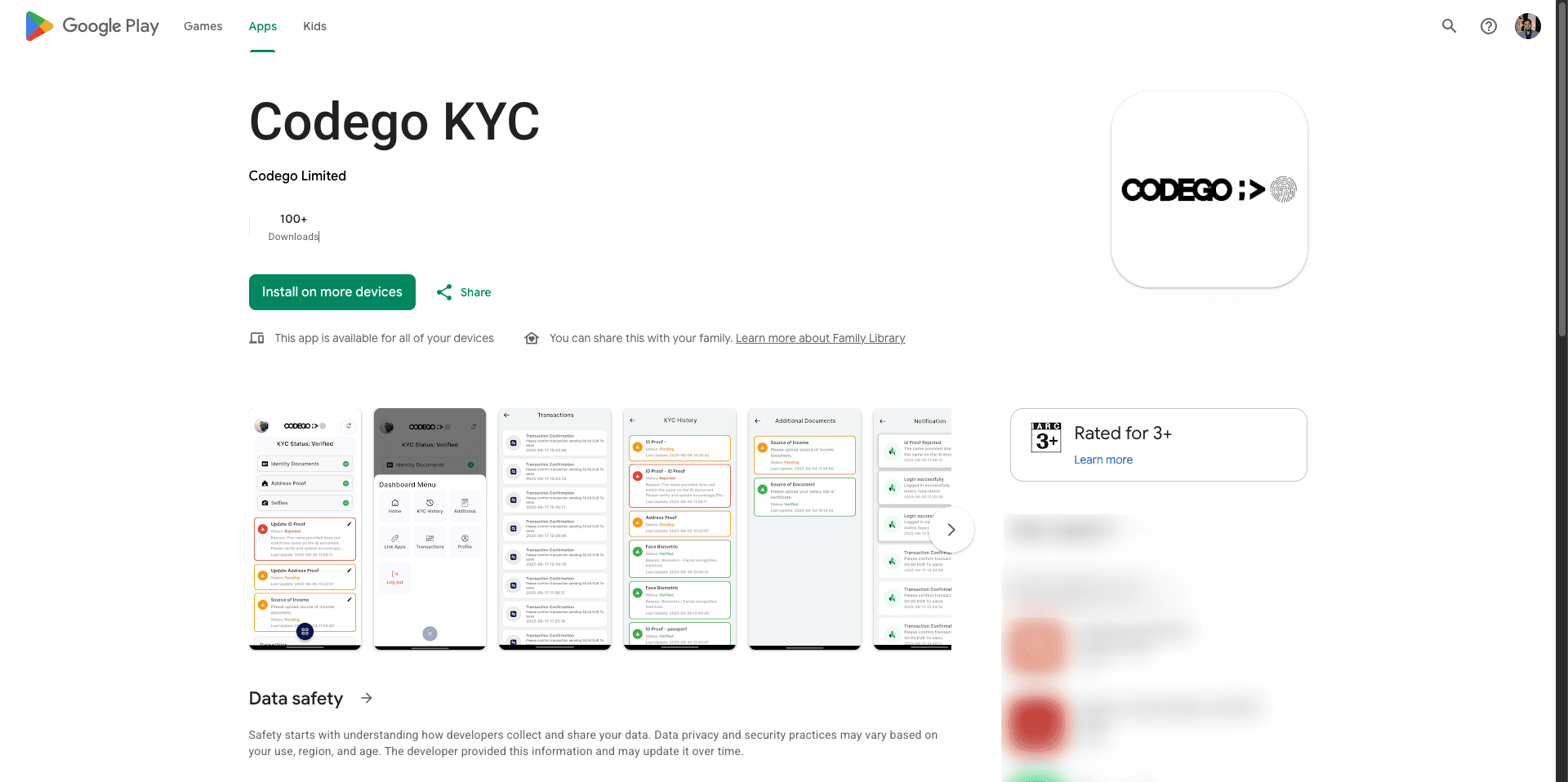
CodegoKYC provides seamless identity verification for FinTech onboarding, featuring automated document scanning and facial recognition.
Regulatory compliance requires strict KYC (Know Your Customer) processes. The app needed a flawless, high-conversion camera and document scanning flow.
02 / CREW
Role and ownership
Flutter Developer at Codego, 2024 - 2026.
Collaborated with backend security engineers and compliance teams.
I engineered the Flutter application, specializing in the camera integrations and local image processing.
Specific verification volumes and internal compliance thresholds are confidential.
03 / GRAVITY
The challenge
- Handling camera permissions and hardware differences across Android devices.
- Ensuring high-quality image capture without excessive file sizes.
- Each submitted document (ID, address proof, selfie/biometric, source of income) needed its own independent verification state (pending, rejected with a specific reason, or verified), so a user whose ID photo was rejected for a name mismatch could fix just that document instead of restarting the entire KYC flow.
04 / TRAJECTORY
Engineering approach
- Implemented strict UI overlays to guide users to take perfect document photos.
- Used native camera plugins with custom focus and exposure controls.
05 / SYSTEMS
What I built
- Delivered a production-ready KYC flow.
- Significantly reduced onboarding drop-off rates through better UX.
06 / NAVIGATION
Technical decisions
Native Camera Integration
Used direct platform channel configurations to ensure maximum camera resolution for document OCR.
10 / SIGNAL
Results and proof
Successfully verified identities for the Codego platform.
Evidence · client-approved
11 / RETURN
Reflection
- Hardware fragmentation on Android makes camera-heavy apps particularly challenging to standardize.